
Which times tables are the hardest?
England's official check names five tables. Here is what the curriculum documents say, and how few facts are really left.
The short answer: 6, 7, 8, 9 and 12
England's Standards and Testing Agency (STA) builds the year 4 multiplication tables check. Its assessment framework explains why some tables get more questions than others:
“There is an emphasis on the 6, 7, 8, 9 and 12 multiplication tables because these have been determined to be the most difficult multiplication tables.”
— Multiplication tables check assessment framework, STA, p. 10
That is the most direct official statement we found. The framework does not publish the data behind it, and it does not rank single facts, so this page does not claim that one particular fact (such as 7 × 8) is “the hardest”. The summary of the national statistics release reports total scores; we did not find results by table in it.
When each table is taught
Most of the hard tables are also taught last. In England, the national curriculum spreads the tables over three years:
| Year | What the programme of study says | Page |
|---|---|---|
| Year 2 | “recall and use multiplication and division facts for the 2, 5 and 10 multiplication tables” | 13 |
| Year 3 | “recall and use multiplication and division facts for the 3, 4 and 8 multiplication tables” | 19 |
| Year 4 | “recall multiplication and division facts for multiplication tables up to 12 × 12” | 25 |
So the 6, 7, 9, 11 and 12 tables first appear as a requirement in year 4 — the same year as the check. Of the five tables the check emphasises, only the 8 table comes earlier, in year 3.
In the United States, the Common Core State Standards do not set an order of tables. They set an end point: by the end of grade 3, students should “know from memory all products of two one-digit numbers” (3.OA.C.7, p. 23). That is the 0–9 range, without 11 or 12.
Fewer facts are left than the chart suggests
A 12 × 12 chart has 144 squares, but many are repeats. Both curricula teach that order does not matter: England's year 2 programme says pupils should “show that multiplication of two numbers can be done in any order (commutative)” (p. 13), and Common Core gives the example “If 6 × 4 = 24 is known, then 4 × 6 = 24 is also known” (3.OA.B.5, p. 23).
If 6 × 7 and 7 × 6 count as one fact, here is what is left after the earlier tables:
| Range | Tables already known | Facts left |
|---|---|---|
| 1–9 | ×1, ×2, ×5 | 21 |
| 1–9 | ×1, ×2, ×3, ×4, ×5, ×8 (England's year 2 and 3 tables, plus ×1) | 6 |
| 1–12 | ×1, ×2, ×3, ×4, ×5, ×8, ×10 | 15 |
The 6 facts left in the 1–9 range are 6 × 6, 6 × 7, 6 × 9, 7 × 7, 7 × 9, 9 × 9.
The 15 left up to 12 × 12 are 6 × 6, 6 × 7, 6 × 9, 6 × 11, 6 × 12, 7 × 7, 7 × 9, 7 × 11, 7 × 12, 9 × 9, 9 × 11, 9 × 12, 11 × 11, 11 × 12, 12 × 12.
These are counts, not a measure of difficulty. Knowing 3 × 8 does not guarantee a child recalls 8 × 3 just as fast, and an earlier table can still be shaky. Check the earlier tables first.
Build a hard fact from easier ones
Common Core's standard 3.OA.B.5 asks students to use properties of operations as strategies, and gives this example:
“Knowing that 8 × 5 = 40 and 8 × 2 = 16, one can find 8 × 7 as 8 × (5 + 2) = (8 × 5) + (8 × 2) = 40 + 16 = 56. (Distributive property.)”
— Common Core State Standards for Mathematics, 3.OA.B.5, p. 23
England's year 4 programme also mentions the distributive law (p. 25), and its guidance gives 39 × 7 = 30 × 7 + 9 × 7 as an example (p. 26).
The idea: a forgotten fact can be rebuilt from facts the child already knows. The fives and twos make a useful base:
- 7 × 6 = 7 × 5 + 7 = 35 + 7 = 42
- 6 × 8 = 5 × 8 + 8 = 40 + 8 = 48
- 9 × 7 = 10 × 7 − 7 = 70 − 7 = 63 (uses ×10, which England teaches in year 2)
Rebuilding is a way back to the answer, not the end goal. The check and the standards both ask for recall from memory, so a rebuilt fact still needs practice until it comes without working out.
What the game does when a fact is missed
Times Table Garden uses the same property in its hints. When a child picks the wrong answer, the game shows the right answer and the fact one step back, plus one more group:
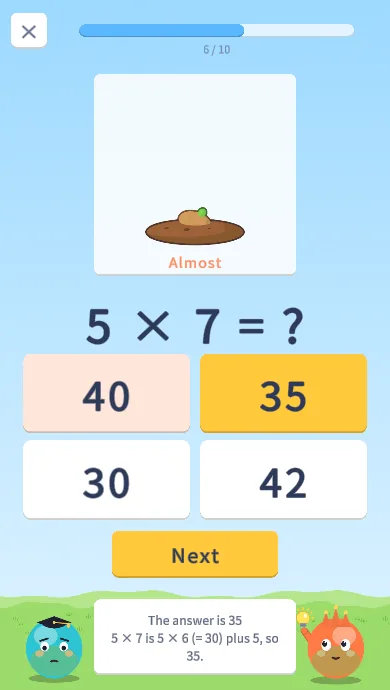
This form is used for every fact except ones with ×1 (those say “Multiplying by 1 keeps it the same” or, for 1 × 7, “It's 7 ones”). The missed fact is asked again up to three questions later in the same round (sooner near the end), at most twice.
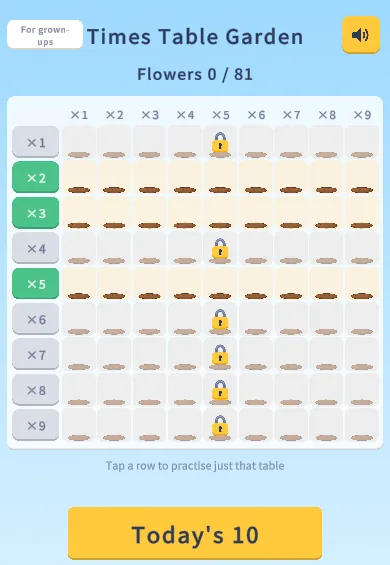
Be aware of the limits: in the English version, only the ×2, ×3 and ×5 tables can be played at the moment, and the game stops at 9, so it does not cover the ×11 and ×12 facts in England's list.
Try it
Practise ×2, ×3 and ×5 freeFree in the browser. No download, no ads, no login. The ×2, ×3 and ×5 tables are free; in the English version the other tables (×1, ×4, ×6–×9) cannot be opened yet. This game covers 1–9 only.
Other guides
Sources
- Standards and Testing Agency. Key stage 2 multiplication tables check assessment framework (from academic year 2021/2022). GOV.UK · PDF (p. 10)
- Department for Education. Mathematics programmes of study: key stages 1 and 2 (national curriculum in England, 2013). GOV.UK · PDF (pp. 13, 19, 25, 26)
- National Governors Association Center for Best Practices & Council of Chief State School Officers (2010). Common Core State Standards for Mathematics, Grade 3, Operations and Algebraic Thinking. corestandards.org · PDF (p. 23)
- Department for Education. Multiplication tables check attainment, academic year 2024/25. Explore education statistics
All sources checked on 21 October 2026. Published 21 October 2026.