
The year 4 multiplication tables check: how it works
25 questions, 6 seconds each, and no pass mark. Everything here comes from the Standards and Testing Agency and the Department for Education.
What it is
The multiplication tables check (MTC) is an on-screen check taken at the end of year 4 in England. It has been statutory since the 2021/22 academic year for eligible pupils at maintained schools, special schools and academies (assessment framework, p. 6).
Its stated purpose is “to determine whether year 4 pupils can fluently recall their multiplication tables”. The framework adds that it “is not intended as a diagnostic tool” (p. 4).
It comes from the year 4 programme of study: “recall multiplication and division facts for multiplication tables up to 12 × 12” (national curriculum, p. 25).
How the check works
- 25 questions, one mark each, all in the form “n1 × n2 =” (p. 9).
- 6 seconds to enter each answer, starting when the question appears. Then a 3-second pause before the next one (p. 9).
- Answers are typed with a keyboard, or with an on-screen number pad using a mouse or touchscreen (p. 9).
- There are 3 practice questions first (information for parents). The whole check should take less than 5 minutes (framework, p. 6).
- Questions are not ordered by difficulty, and each pupil gets one of several equivalent forms at random (p. 9).
- It is held in June, in a 3-week window; schools choose the day (p. 9). The exact dates for each year are in the key stage 2 assessment and reporting arrangements (ARA).
The 6-second limit is meant to allow recall but not working out. The framework says it was informed by STA research in which 1,124 pupils took part and three time limits were trialled (p. 8).
Which tables come up
Questions are drawn from the 121 facts of the 2 to 12 tables. The ×1 table is not part of the check (it may appear in practice questions) (p. 9). Each form has a minimum and maximum number of questions from each table:
| Table | Min per form | Max per form |
|---|---|---|
| ×2 | 0 | 2 |
| ×3 | 1 | 3 |
| ×4 | 1 | 3 |
| ×5 | 1 | 3 |
| ×6 | 2 | 4 |
| ×7 | 2 | 4 |
| ×8 | 2 | 4 |
| ×9 | 2 | 4 |
| ×10 | 0 | 2 |
| ×11 | 1 | 3 |
| ×12 | 2 | 4 |
Multiplication tables check assessment framework, Table 1, p. 10. The first number in the question decides the table (4 × 12 counts as the 4 table).
The framework explains the weighting: “There is an emphasis on the 6, 7, 8, 9 and 12 multiplication tables because these have been determined to be the most difficult multiplication tables” (p. 10). The 2, 5 and 10 tables, taught in key stage 1, make up 3 to 7 of the 25 questions (p. 11). A fact and its reverse (3 × 8 and 8 × 3) never appear in the same form (p. 11).
Is there a pass mark?
No.
The information for parents says: “There is no pass mark for the check.” The assessment framework says: “There is no expected standard threshold for the MTC” (p. 11). Each school receives a score out of 25 for each pupil, and the child's teacher shares the score with parents.
For context, the Department for Education's official statistics for summer 2025 report:
- an average score of 21.0 out of 25 (20.6 in 2024; 19.8 in 2022);
- 37% of eligible pupils scored full marks (25), the most common score;
- 96% of eligible year 4 pupils took the check.
Multiplication tables check attainment, academic year 2024/25 (published 20 November 2025). We did not find results by table or by question in the release summary.
Does my child need to prepare?
The government's information for parents says: “No, you do not need to do anything additional to prepare your child for the check. As part of usual practice, teachers may ask you to practise times tables with your child.”
It also says schools have unlimited access to a “try it out” area from April, so pupils can get used to the check screen and any access arrangements.
How Times Table Garden compares
Times Table Garden is not the check and does not copy it. The main differences:
| The MTC | Times Table Garden | |
|---|---|---|
| Tables | 2 to 12 | 1 to 9. In the English version, only ×2, ×3 and ×5 can be played for now |
| Answer | Typed | Picked from four choices |
| Time | 6 seconds per question, then it moves on | No countdown. A fact becomes a flower only if it is answered correctly within 6 seconds once it has reached the bud stage |
| Length | 25 questions | A round starts with 10 questions; a missed fact is asked again later in the round (at most twice), so a round can run longer |
| Result | Score out of 25 for the school | Shows the child how many were correct; no score is shared, and progress is kept in the browser |
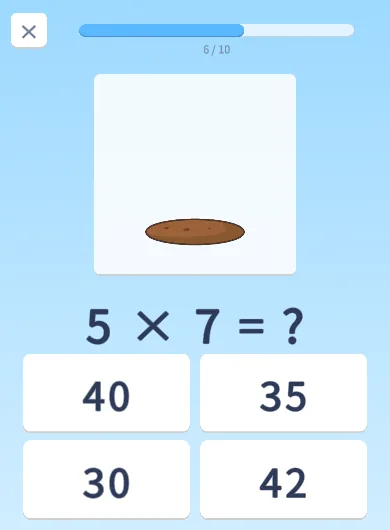
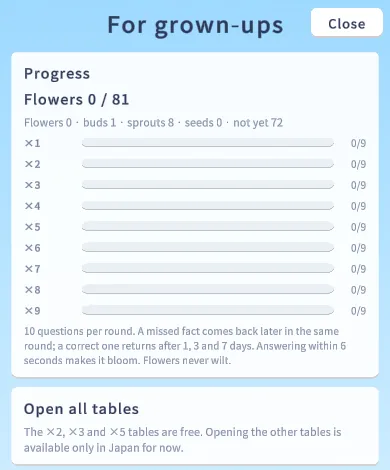
Because answers are chosen rather than typed, and the ×6–×12 facts are not available in the English version, the game is not a practice version of the MTC. What it offers is four-choice practice of the 2, 3 and 5 tables, without a clock on screen.
Try it
Practise ×2, ×3 and ×5 freeFree in the browser. No download, no ads, no login. The ×2, ×3 and ×5 tables are free; in the English version the other tables (×1, ×4, ×6–×9) cannot be opened yet. This game covers 1–9 only.
Other guides
Sources
- Standards and Testing Agency. Key stage 2 multiplication tables check assessment framework (from academic year 2021/2022). GOV.UK · PDF (pp. 4, 6, 8–11)
- Standards and Testing Agency. Multiplication tables check: information for parents (STA/26/9098/e, 2025). GOV.UK
- Department for Education. Multiplication tables check attainment, academic year 2024/25 (published 20 November 2025). Explore education statistics
- Department for Education. Mathematics programmes of study: key stages 1 and 2 (national curriculum in England, 2013). GOV.UK · PDF (p. 25)
- Standards and Testing Agency. Key stage 2: assessment and reporting arrangements (ARA). GOV.UK
All sources checked on 21 October 2026. Published 21 October 2026.